The ECI has a Form 6 route. Where is the ledger?
The Supreme Court will hear Delhi’s dispute on October 28, two days before the reported claims deadline. The missing numbers are the point.
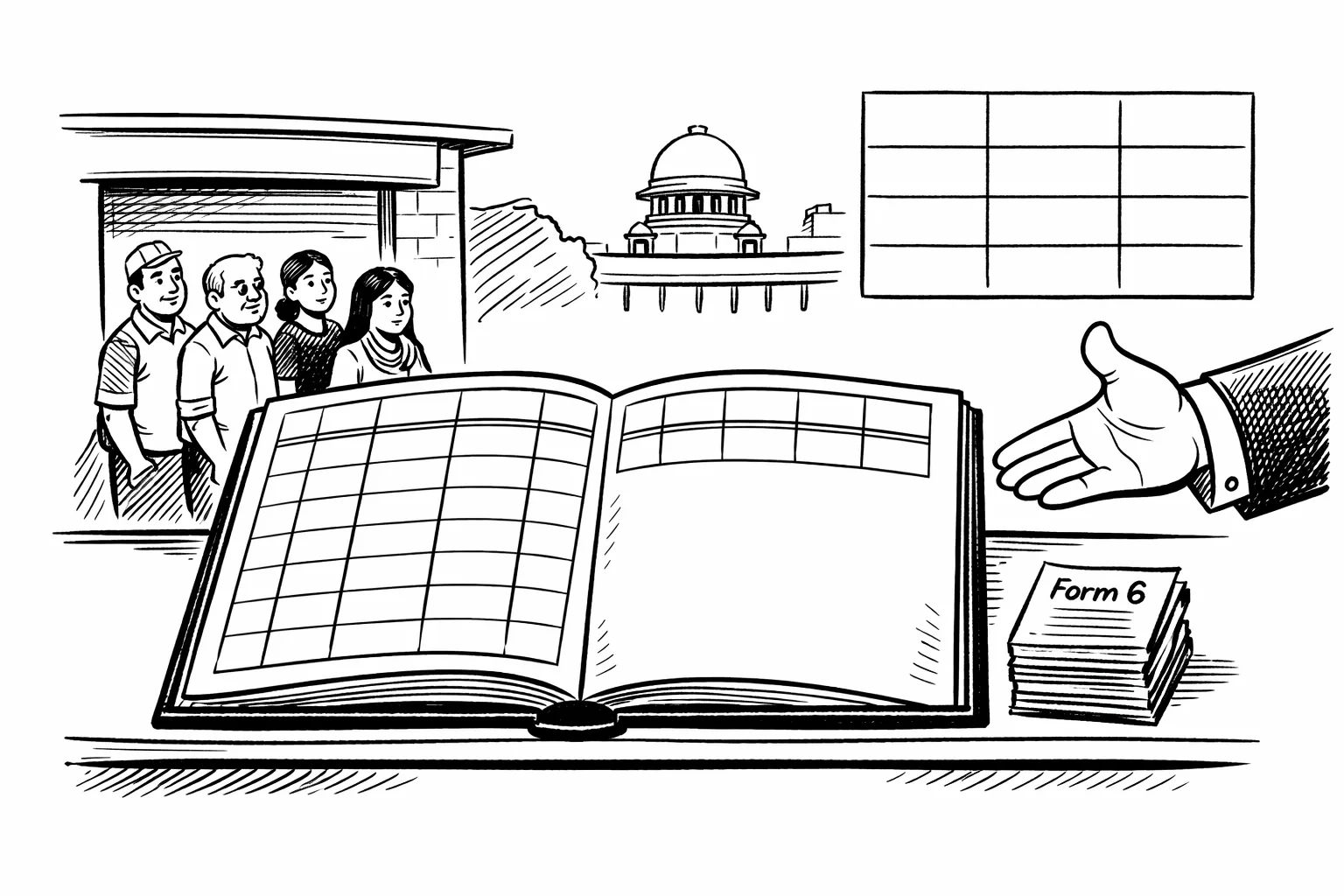
The forms are public. The outcome ledger is not.
The Election Commission of India calls Special Intensive Revision a “participative exercise”. It has not, however, published the one ledger that would show whether the exercise is restoring eligible voters: applications filed, accepted, rejected and still pending.
That gap is now before the Supreme Court. The court has advanced the Delhi hearing on the Form 6 dispute to October 28, two days before the reported October 30 deadline for claims and objections, after advocate Prashant Bhushan raised the issue. The applicants, Anjali Bhardwaj and Amrita Johri, say people whose names were removed during the revision are being directed to use Form 6, the ECI’s ordinary inclusion form, rather than a distinct restoration route. The court has not finally ruled that Form 6 is inadequate.
The ECI’s own public material makes the procedural awkwardness plain. Its FAQ says a person whose name is not on the electoral roll must submit Form 6. Its voter portal labels Form 6 “New Voter Registration”, while Form 8 is described as the form for correcting mistakes in electoral rolls. The SIR portal adds a Form 6 declaration and a facility to submit documents against a notice. What it does not provide is a public account of how previously enrolled voters are being treated after exclusion.
The Delhi application cites 47,56,722 electors — 32.78% of the pre-revision electorate — as excluded from the draft roll under the ASDD categories: Absent, Shifted, Dead or Duplicate. That is an applicant’s figure about a Delhi draft roll, not proof of permanent deletion and not a national total. The ECI has published process numbers for Phase III — 36.73 crore electors, 3.94 lakh booth-level officers and 3.42 lakh booth-level agents — but process theatre is not an outcome ledger.
The ECI may have a form for re-entry. It has yet to show the public the results of using it. The Supreme Court is now being asked to inspect the receipt Delhi’s election machinery forgot to publish.