Renew the Same Job, Pay $4,000: America's New H-1B Math Lands on India's Engineers
From September 9, Washington will charge a “9/11 biometric fee” every time an Indian engineer renews the very same job they've held for years. The employer pays — but it's the diaspora that feels it.
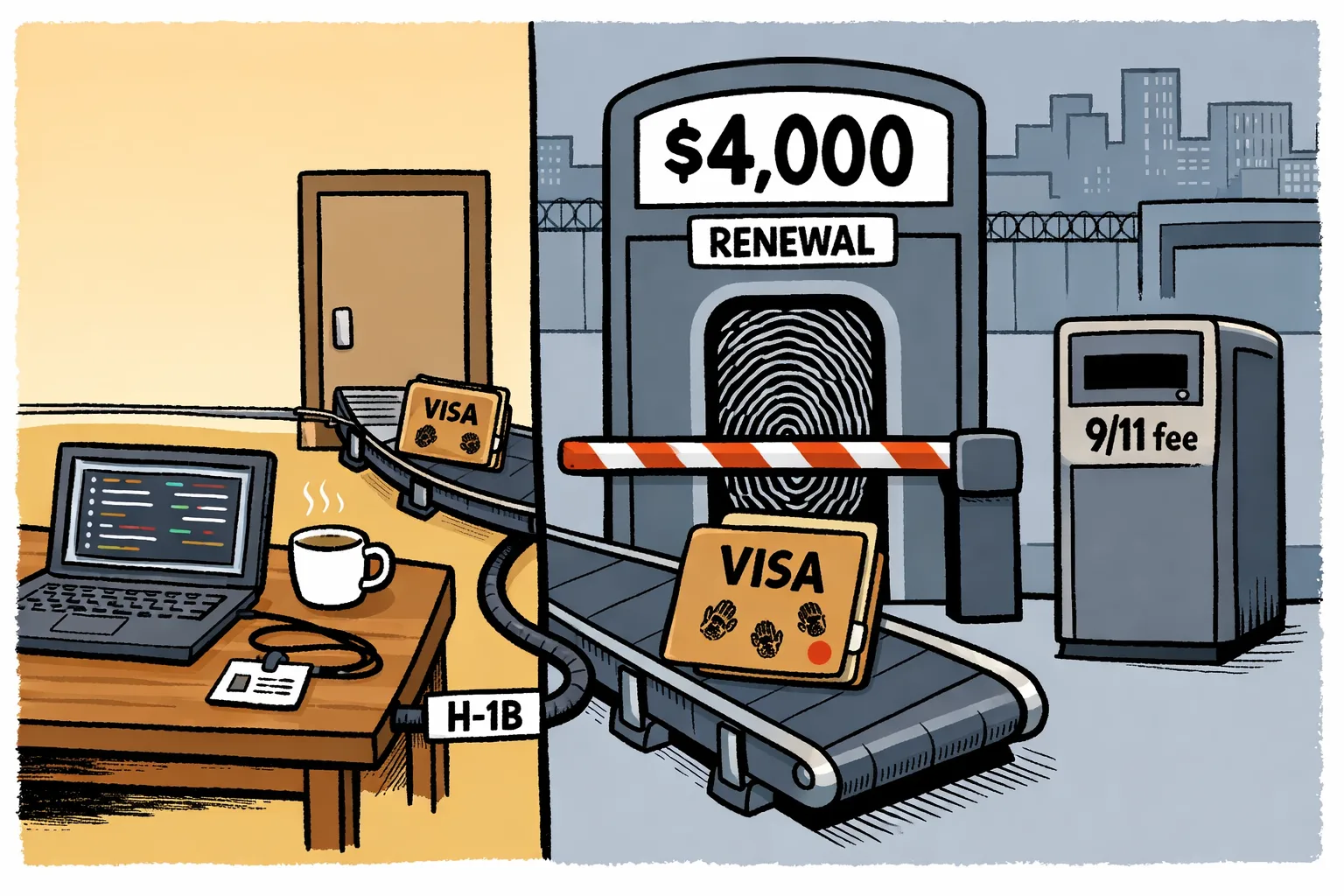
The new fee applies to certain H-1B extensions from September 9, 2026.
There is a particular genius to American immigration policy, and it is this: it has found a way to charge you for standing still.
On Monday, the Department of Homeland Security published a rule in the Federal Register that, from September 9, 2026, extends the long-standing $4,000 (H-1B) and $4,500 (L-1) "9/11 Response and Biometric Entry-Exit Fee" to extension petitions — including the most routine kind of all: the same worker, at the same employer, doing the same job, asking to keep doing it.
Until now, that fee — a creature of Public Law 114-113, the 2016 appropriations act — mostly bit on new hires and job-switchers. An extension of the status quo was, fittingly, free. No longer. Renew a visa for an Indian software engineer who has been writing the same firm's code in Texas for six years, and the employer now writes a $4,000 cheque for the privilege of nothing changing.
Read the fine print and the target becomes unmistakable. The fee applies to the so-called "50/50" employers — companies with 50 or more U.S. staff, more than half of them on H-1B or L-1 visas. That is not a description of Google or Microsoft. That is a near-exact profile of the Indian IT services industry — the TCS-Infosys-Wipro-Cognizant-HCL axis and the thousand mid-tier body-shops beneath them — which is to say, the single largest employer of India's engineering diaspora.
So let us be clear about who actually pays. Officially, the employer does. In practice, a fee that lands on every extension is a tax on keeping Indian workers employed in America — and costs a company plans around have a way of trickling down to the people whose renewals just got more expensive to justify. Fewer extensions filed, more "let's see next year," more families from Bengaluru to Hyderabad to Pune refreshing a case-status page at 3 a.m.
The rule is billed as funding "border security" and "biometric entry-exit systems". One struggles to picture the border being made safer by an Indian engineer, fingerprinted five times already, renewing a badge to a building he has entered every weekday since 2019. But the fee has a name with "9/11" in it, and names like that are how uncomfortable line items get waved through.
It runs, for now, through September 30, 2027, unless Congress extends it — which, on current form, is the safest bet in Washington. It arrives after a year in which the cost of simply being an Indian on an American work visa has only ever gone in one direction.
None of this is abstract for India. The road that runs from the country's coaching classes and engineering colleges to a cubicle in Dallas or Edison runs almost entirely on these two visas. Washington has just quietly raised the rent on that road — and mailed the bill to the very diaspora, from every state in India, that built half of American IT.