
AP’s Education Revolution Has Reached the Teachers’ Hunger Strike
The government filled thousands of posts swiftly, then asked experienced teachers to prove they belong in classrooms.
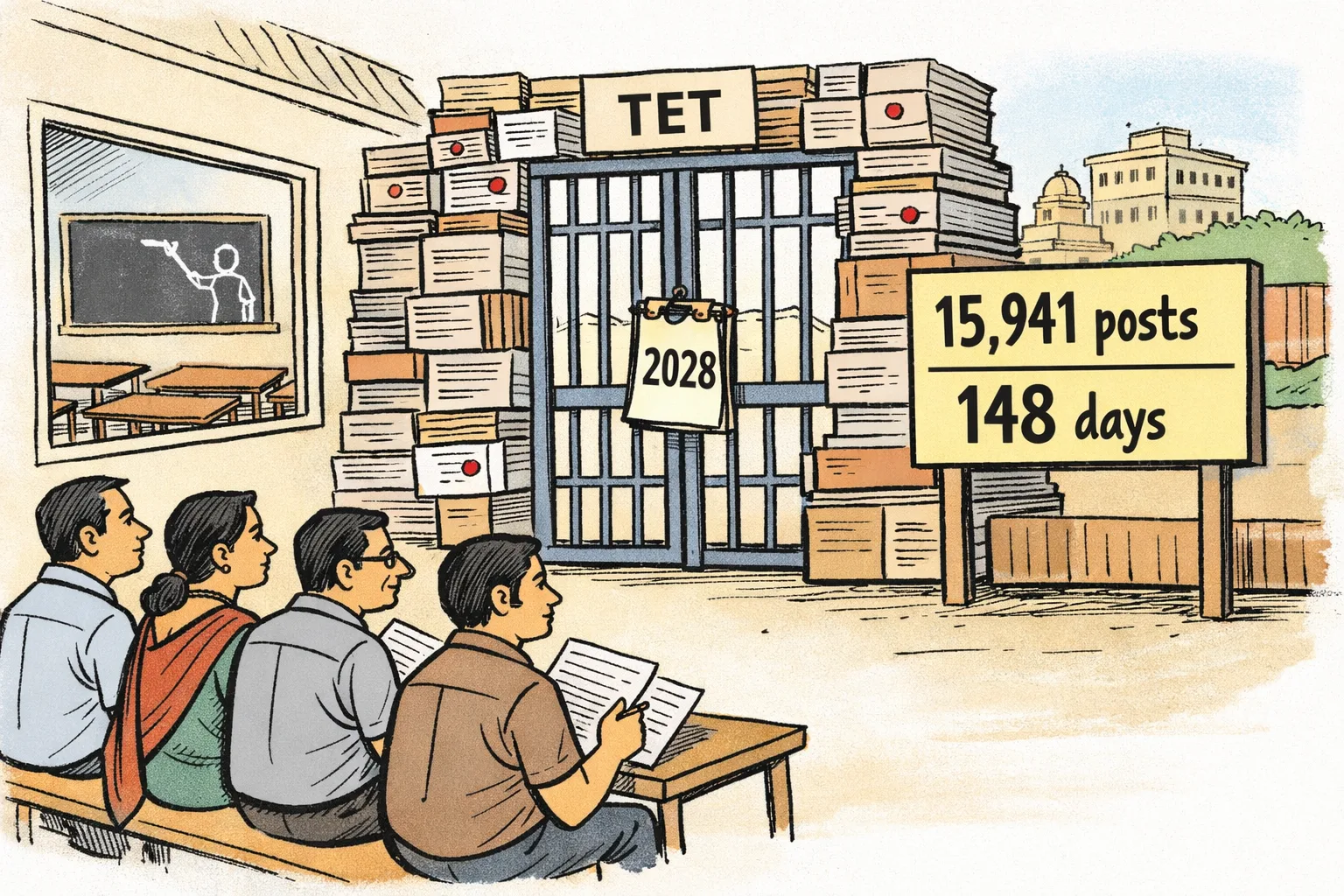
Nara Lokesh’s education model is moving at remarkable speed. The Andhra Pradesh government says it notified 16,347 posts, filled 15,941 of them, processed 3.36 lakh applications and completed appointments in 148 days. It is a handsome administrative achievement, and the government has every right to advertise it. It has also advertised an education system in which teachers are apparently the only people expected to keep requalifying for work they already perform.
The AP United Teachers’ Federation has announced an indefinite hunger strike from 4 September at Vijayawada’s Alankar Centre. Its demand is not that examinations disappear from the universe. It wants relief for teachers appointed before the Teacher Eligibility Test became compulsory, and wants the TDP-led government to press the Union government for an amendment to the Right to Education Act. The Supreme Court’s ruling requires certain pre-2011 in-service teachers to qualify within two years. The state’s answer is a special TET, exclusively for them, with a deadline of 31 August 2028.
This is where the government’s education story acquires a useful second chapter. The first chapter has recruitment figures, annual DSC promises and the slogan “One Class, One Teacher”. The second has serving teachers being told that years in classrooms are not quite the same as being eligible to stand in one. The state says it is helping them comply with the law. The teachers say the law is being applied to people appointed under a different rulebook. Both positions can be printed on official stationery. Only one requires people to go hungry in Vijayawada.
Lokesh has political access in Delhi through the NDA. That should, in theory, make the Centre-state relationship more useful than a joint photograph and a carefully worded statement. Instead, Delhi writes the rule, Amaravati administers the distress, and everyone gets to call it coordination. The government can reasonably say the Supreme Court’s order leaves it limited room. It cannot reasonably say that a hunger strike by its own serving teachers is evidence of educational transformation.
The teachers were appointed before TET was compulsory; the government has given them until 31 August 2028 to become eligible for jobs they have already held.
More from The Column
- Tollywood’s Biggest Blockbuster Is the Collection PosterThe film opens once; the PR machinery keeps celebrating until arithmetic applies for leave.
- A Thousand Days, Defeated by a Black T-ShirtRevanth Reddy’s government has discovered that cotton is more threatening than questions about its promises.
- Andhra Pradesh Clears ₹30,000 Crore — Mostly by Announcing It AgainNaidu’s government has discovered a revolutionary fiscal instrument: returning employees’ money and calling it generosity.
- Telangana Congress Finds Discipline, Misplaces DemocracyA minister exits over a ticket dispute while teachers are asked to wait, proving patience is strictly for people without power.