India’s New Democracy Test: Prove You Exist Before Voting
The Election Commission has turned citizenship into a document hunt and called the queue administrative housekeeping.
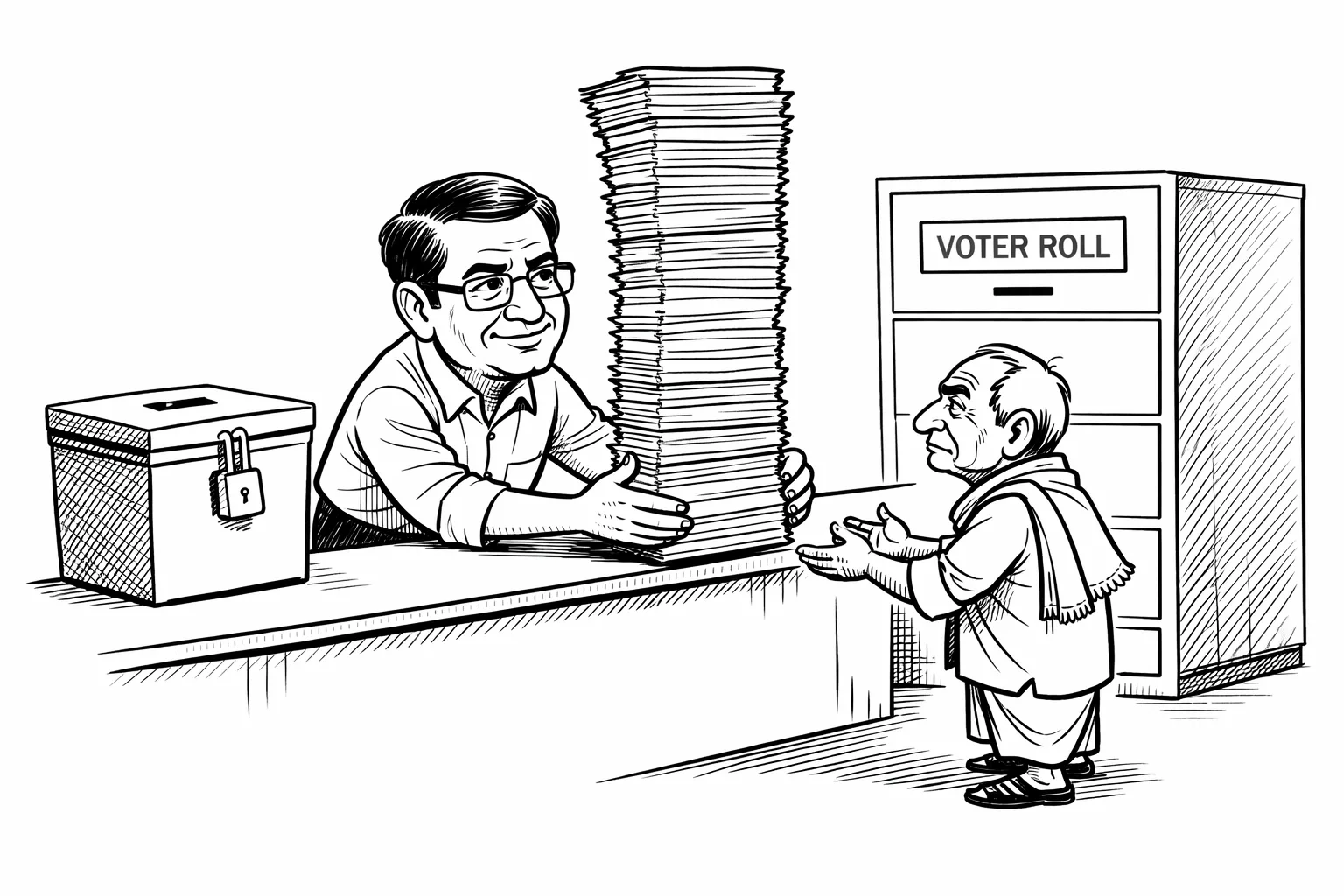
India’s electoral system now offers a thrilling new civic privilege: the chance to prove that you exist before being allowed to vote. The Election Commission’s Special Intensive Revision, conducted under Chief Election Commissioner Gyanesh Kumar, has affected more than 130 million names across the exercise. That is the political shorthand, not a final judicial finding that 130 million eligible citizens have permanently lost their votes. The distinction matters. It also does not make the number look remotely like routine housekeeping.
The Commission says the names include dead people, duplicates, voters who shifted permanently and others who could not be verified. Reported break-ups include roughly 95 million categorised as absent, shifted or “other”, 27 million as deceased and 10 million as duplicates. Fine. Every electoral roll needs cleaning. But when the cleaning produces millions of appeals, protests, Supreme Court intervention and reported objections from Election Commissioners Sukhbir Singh Sandhu and Vivek Joshi on at least 14 occasions, the public is entitled to notice that the mop has acquired political ambitions.
In Bihar, the Supreme Court took the final handling of around 60 lakh voters flagged for “logical discrepancies” away from the Commission and placed it before judicial officers. The ECI later said 38 lakh appeals were pending before tribunals, including 22.21 lakh appeals by deleted voters seeking restoration. Somewhere in this process, democracy stopped being a right and became a customer-service dispute: please submit proof of your address, ancestry, continuity and continued existence to the department that was supposed to know you were there.
The Modi government and Gyanesh Kumar’s Commission may insist that this is neutral administration. That is the beauty of procedural language: it can make a mass anxiety sound like photocopying. Opposition protests, including Rahul Gandhi’s detention, are then treated as political theatre, as though the people being asked to prove their identity are merely interrupting the filing system. Telangana should pay attention. The same national machinery will eventually ask voters here to trust its memory while millions elsewhere are appealing to recover theirs.
The problem is not that electoral rolls are checked. It is that the citizen now has to prove not merely that they are alive, but that the Election Commission remembers them. In the new India, the vote is still secret; the process for losing it is not.
More from The Column
- Andhra Pradesh’s Great Nomination EscapeIn Naidu’s Andhra, democracy may enter the building after the ruling coalition checks its paperwork.
- Revanth Reddy’s Government Has Entered Its 15% EraA ₹3,296-crore road now comes with a cheaper bid, a missing comparison sheet and an allegation that demands an answer.
- 130 Million Voters Vanish, Delhi Calls It HousekeepingThe government has perfected a new democratic service: delete citizens first, then ask them to prove they exist.
- Telangana’s New Tender Policy: Qualify First, Pay LaterA written commission allegation has met the government’s oldest infrastructure project: the press release before the road.