India’s Voter List Has Entered Its Weight-Loss Era
The Election Commission wants citizens to prove they exist, then calls millions of missing names administration.
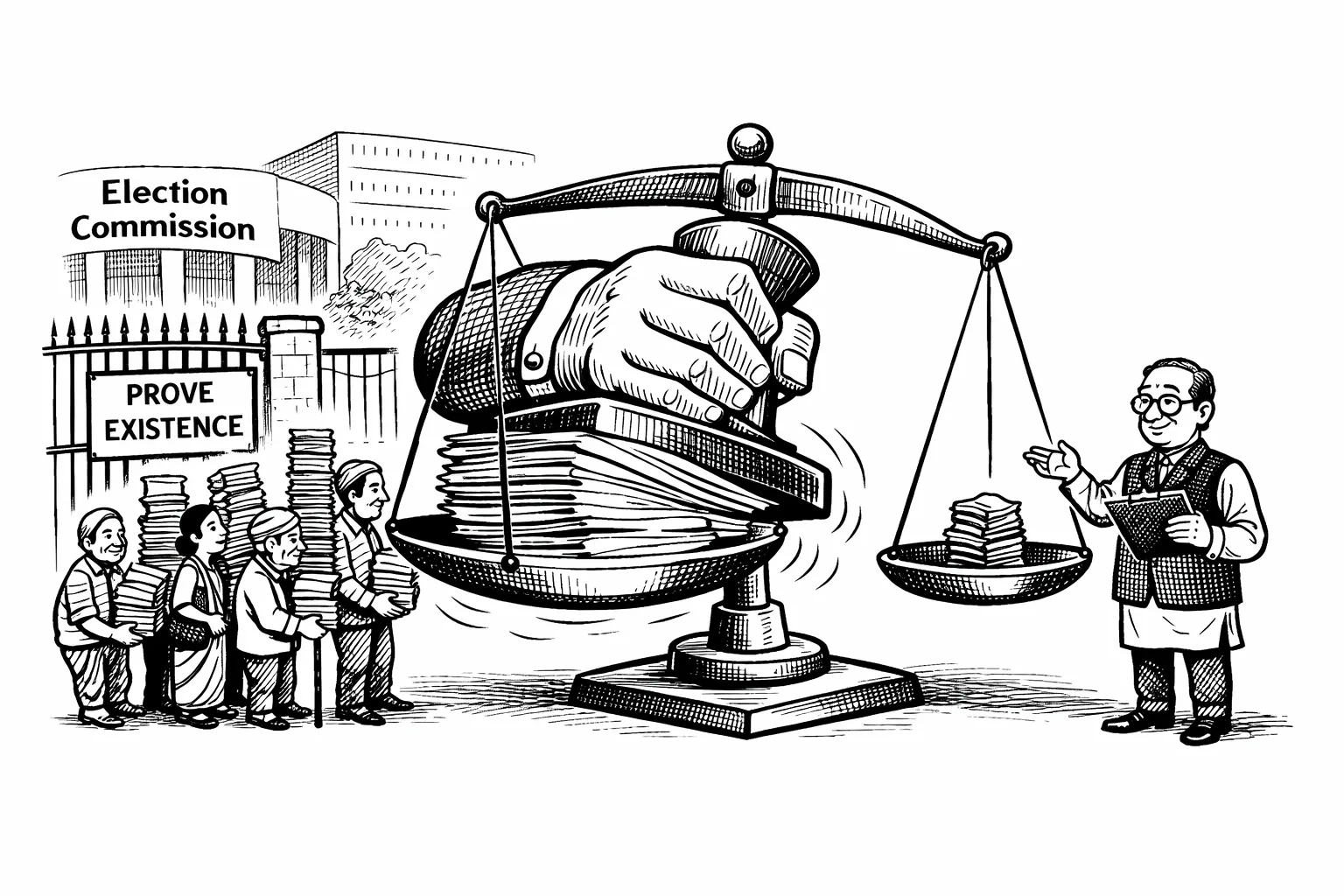
India’s Election Commission says the Special Intensive Revision is a housekeeping exercise: remove duplicates, exclude ineligible voters and retain every legitimate citizen. A noble objective, presented with the warm administrative charm of a locked gate. The practical instruction is less elegant: produce old documents proving who you are, where you came from and, presumably, that your grandmother maintained a filing system. For millions of poorer citizens, migrants and people whose paperwork has never enjoyed the state’s confidence, this is not a formality. It is an obstacle course designed by people who already possess every document required to survive it.
The numbers are doing more political work than the press releases. Election Commission data indicates that rolls could shrink by as much as 30 per cent in some regions. In West Bengal, around nine million names were removed, roughly 12 per cent of the electorate, with critics saying eligible voters were left unable to vote. The official defence is that the process protects the genuine voter. That is the administrative equivalent of announcing a hospital renovation after removing the patients.
Then came the institutional theatre. The opposition demanded Chief Election Commissioner Gyanesh Kumar’s resignation. Rahul Gandhi said he wanted to tell Kumar he had done “vote chori”, then followed it with the more direct: “Gyanesh it’s done bro. Time to resign.” Parliament Street was barricaded, opposition leaders including Rahul Gandhi and Priyanka Gandhi Vadra were detained, and the people demanding answers were kept away from the institution that administers the answer. The Election Commission says disagreements among commissioners were merely “differing views and deliberations”; the Indian Express reported that two commissioners objected 14 times in 10 months. Democracy, apparently, now comes with internal footnotes and external barricades.
The BJP calls the opposition’s allegations misleading. Perhaps. But when a voter list can lose millions of names, when citizens must produce an archive to prove they belong, and when elected politicians are detained outside the election office, “trust us” is not transparency. It is a demand for obedience dressed as procedure. Telangana should watch this closely: a roll is not a spreadsheet above society. It decides who gets to speak, and whose voice is quietly classified as duplication.
The government wants every voter to produce a family archive to prove they exist, while the Election Commission treats a 30 per cent disappearance rate as administration.
More from The Column
- Revanth Reddy’s Free Speech Has One Convenient ExitAccuse the KCR family and it is democracy; question the Chief Minister’s family and the police discover urgency.
- The Election Commission Has Misplaced Form 6Citizens must prove they belong in democracy while the institution cannot prove what the Supreme Court approved.
- Telangana’s Drought Plan: First, Form a CommitteeWith 235 mandals facing drought-like conditions, the government has discovered its most dependable crop: paperwork.
- The Voter List Is Being Cleaned Of VotersDelhi calls it verification; citizens are left wondering whether democracy now requires an ancestral property file.