Telangana’s Water Went Downstream. Congress Sent Advice
After letting alleged water losses mount, the government has discovered the farmer’s duty to conserve.
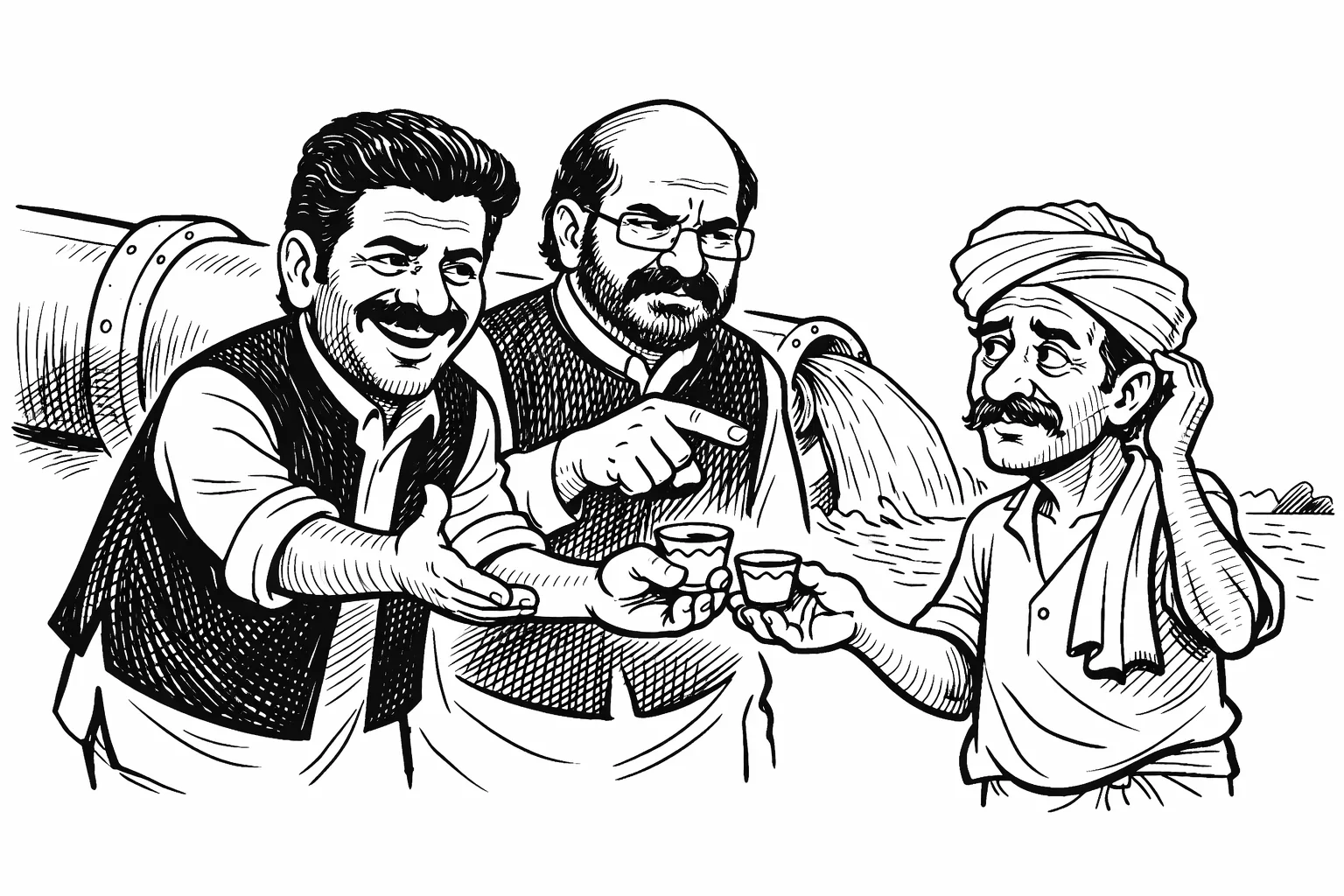
Telangana’s irrigation policy now resembles a badly managed bucket: water enters at the top, political excuses leak from every side, and farmers are told to drink less. On October 16, KTR alleged that more than 750 TMCft of Godavari water and 250 TMCft of Krishna water had flowed downstream since June 1. He said the Kannepalli, Devadula, Palamuru–Rangareddy and Kalwakurthy pumps could have been used to fill reservoirs and tanks. The government’s rebuttal, so far, has the intellectual heft of a calendar reminder: defer one crop cycle and save water and power.
There was, admittedly, an 18 per cent rainfall deficit between June 1 and October 1 — 615.6 mm against a normal 746.3 mm — and power demand crossed 20,000 MW. Climate is real. So is El Niño. But the Congress government did not inherit a surprise parcel from Mars labelled “Drought, handle urgently”. It inherited forecasts, pumps, reservoirs and a state whose economy depends on irrigation. A report also alleged that the Narlapur pump house was not operated for 76 days after Srisailam inflows began, with irrigation for roughly four lakh acres consequently claimed to have been lost. The government has not yet produced an explanation stronger than blaming the previous administration for building the machinery it now cannot operate.
This is where Revanth Reddy’s promise to protect Telangana’s water interests meets the practical genius of his administration. Andhra Pradesh is accused of moving water through Pattiseema, Pothireddypadu and the Veligonda tunnel towards its own regions. Telangana, meanwhile, appears to be conducting a committee-level farewell ceremony for water that was available but not lifted. The Chief Minister and Irrigation Minister Uttam Kumar Reddy can call it conservation, rationalisation or a temporary crop adjustment. The farmer is less interested in the label than in whether the state secured the water before advising him not to use it.
The government’s ideology is now clear: every working pump is inherited politics, every idle pump is administrative complexity, and every missing crop is a conservation success. This is not drought management. It is failure management with a press note. Telangana has not merely faced a water shortage; it has faced a government unable to decide whether irrigation is infrastructure, evidence against the previous regime or somebody else’s department.
More from The Column
- Andhra Pradesh’s Great Nomination EscapeIn Naidu’s Andhra, democracy may enter the building after the ruling coalition checks its paperwork.
- Revanth Reddy’s Government Has Entered Its 15% EraA ₹3,296-crore road now comes with a cheaper bid, a missing comparison sheet and an allegation that demands an answer.
- 130 Million Voters Vanish, Delhi Calls It HousekeepingThe government has perfected a new democratic service: delete citizens first, then ask them to prove they exist.
- Telangana’s New Tender Policy: Qualify First, Pay LaterA written commission allegation has met the government’s oldest infrastructure project: the press release before the road.