
Tollywood’s Biggest Opening Is Still the Press Release
Before the film opens, its publicity department has already announced the victory, the record and occasionally the weather.
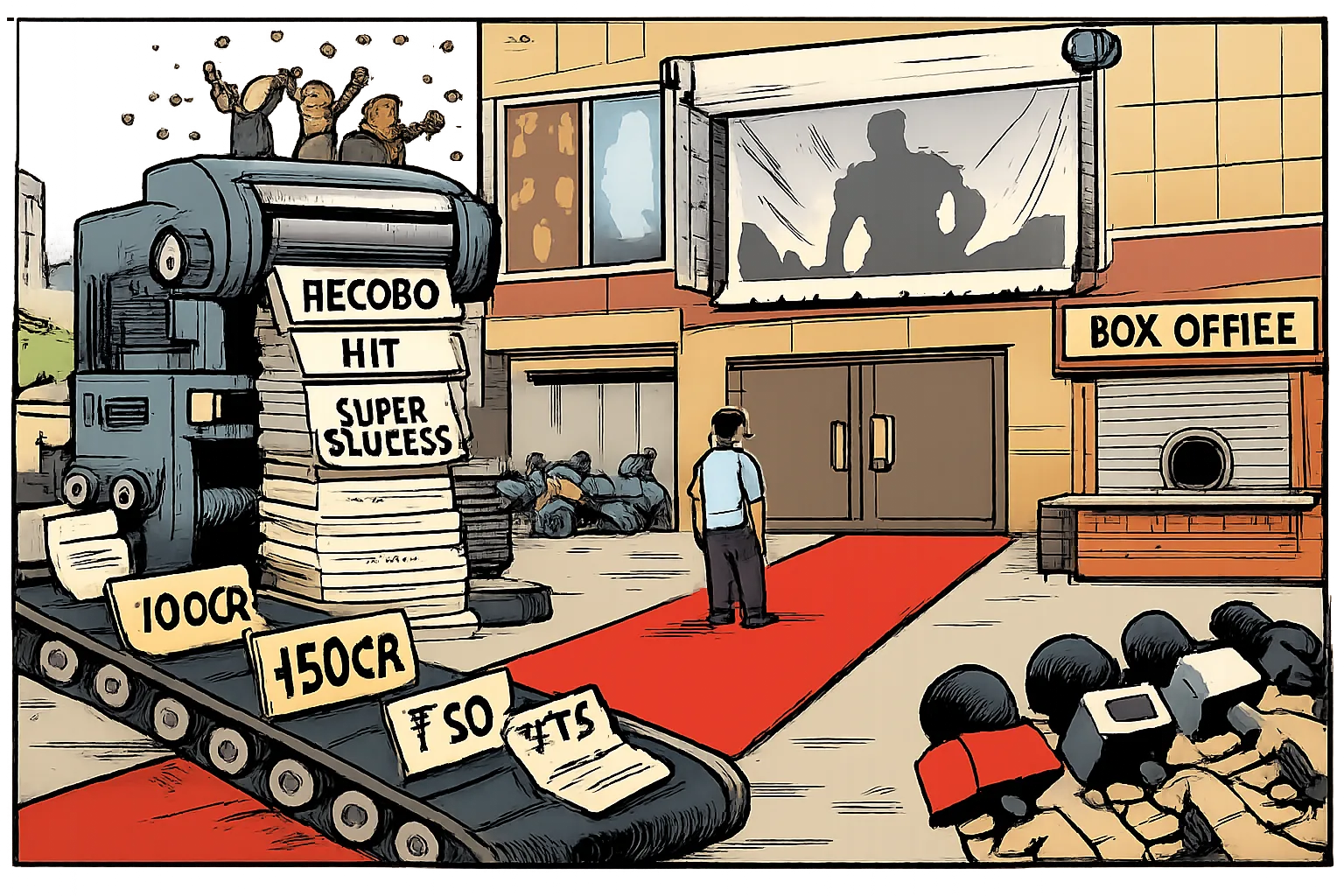
Tollywood has released a new genre before The Paradise: the pre-emptive box-office victory story. Before Nani’s film reached theatres on 24 September 2026, a trade report announced theatrical rights of ₹103.7 crore, including ₹75.7 crore from the Telugu states, and calculated that the film would need roughly ₹200 crore worldwide to become a “super success”. The film had not opened. Its valuation had already been given a red-carpet welcome.
This is the industry’s preferred production schedule. First comes the poster. Then the teaser. Then the headline announcing the biggest-ever business for a Tier-2 hero. Then the break-even mathematics, delivered with the spiritual confidence of an audited balance sheet. On day one, The Times of India reported ₹34.65 crore net in India and ₹54.90 crore gross; Cinema Express carried the same net figure, while Sacnilk put the worldwide gross at ₹76.90 crore, including ₹22 crore overseas. Different estimates are normal. Treating each estimate as scripture until the next graphic needs a larger number is the business model.
The PR machine does not wait for a film to succeed. It merely waits for a suitable adjective. Day One is a record. Day Two is a trend. Day Three is a storm. By Monday, an empty seat has apparently become a strategic theatrical decision. Producers supply the claims, trade portals supply the arithmetic, PR shops supply the posters, and fan armies defend the valuation as if they personally underwrote the distribution deal. Somewhere in the middle, a movie is expected to exist.
The paid movie-journalist ecosystem has also discovered that a review need not discuss the film. It can discuss loyalty, insult, regional pride, childhood memories and the imaginary war between one hero’s shareholders and another’s. A critic saying the screenplay is weak is treated as an attack on civilisation. A graphic announcing a gross figure is treated as evidence from the Supreme Court of Entertainment.
The Paradise may recover its reported business. It may become a success. It may not. That is what the coming weeks are for. The film is still earning its verdict; the publicity department has already collected it.
More from The Column
- Telangana Asked for Clear Titles, Got a Political WarrantyThe government has put land records on committee time while opposition names receive premium administrative attention.
- The Election Commission Has Discovered That “Unanimous” Is a Wonderful WordFourteen objections, centralised control and disputed deletions later, democracy has been assured that everyone agreed.
- Revanth Reddy’s Government Counts Days, Not DeliveriesAfter 1,000 days in office, Congress has discovered the safest achievement: a number nobody can inaugurate.
- Tollywood’s Biggest Opening Is Still the Press ReleaseBefore the second show, the publicity machine has already awarded itself the trophy, audited by nobody visible.