HC to State: urgency isn’t a shortcut
Telangana High Court has reportedly quashed the 2008 Section 6 declaration over petitioners’ land tied to a Mid Manair resettlement zone, saying ‘public purpose’ doesn’t erase owners’ right to be heard. The Section 4(1) notice stands; the State can start over—properly this time.
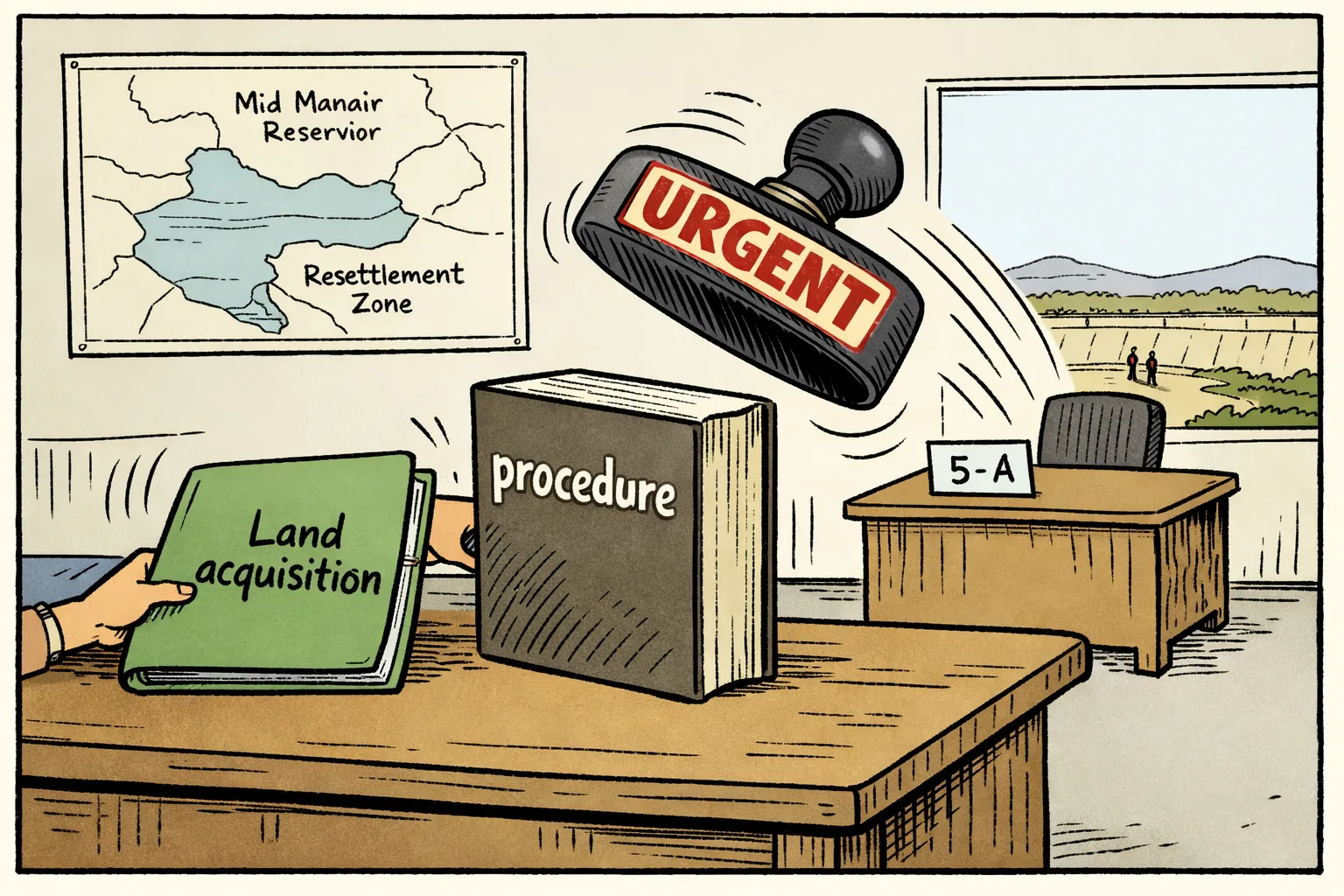
The High Court set aside the Section 6 declaration for the petitioners’ parcels and left the State free to proceed afresh under the law.
News | The Telangana High Court has, per a detailed report, set aside the March 21, 2008 Section 6 declaration insofar as it covered the petitioners’ land for a Resettlement Zone linked to the Mid Manair Reservoir Project, while leaving the January 16, 2008 Section 4(1) notification undisturbed. According to the judgment described, Justice Vakiti Ramakrishna Reddy held that “public purpose” is not the same thing as “so urgent we skip Section 5‑A.”
The Court treated dispensing with objections under Section 5‑A via Section 17(4) as exceptional, and said the State hadn’t shown circumstances that made even a summary hearing impossible. It also flagged a basic contradiction: the State’s counter said Section 17 wasn’t used, but the contemporaneous Gazette recorded invocation of Sections 17(1) and 17(2). If the State’s case was that a 5‑A enquiry happened, it needed to prove compliance; if it was waived, it needed to prove a lawful 17(4) order. Neither was established, per the report. An “urgent” acquisition paired with an award enquiry only in August 2009 didn’t help the urgency story either.
On the 2013 Act’s Section 24(2), the Court reportedly said time under an interim status quo order can’t be counted toward the five years—while clarifying that this did not cure the independent defects in the 1894‑Act process. The operative relief, as reported, is narrow: quashing the Section 6 declaration for the petitioners’ parcels and permitting the authorities to proceed afresh under the current law if the land is still needed for the stated public purpose.
For Telangana readers, the signal is clear: courts will not let “public purpose” become “paperwork optional.” The BJP‑led Centre’s fondness for speed-over-safeguards and the Congress’s habit of discovering process only when in opposition both meet the same wall here—the statute still applies. The State can re‑acquire if it must; it just has to do the hearing it tried to skip.