
Tollywood’s Box Office Has Entered Creative Accounting
The poster says ₹236 crore, the receipts remain off-screen, and the fan wars call this transparency.
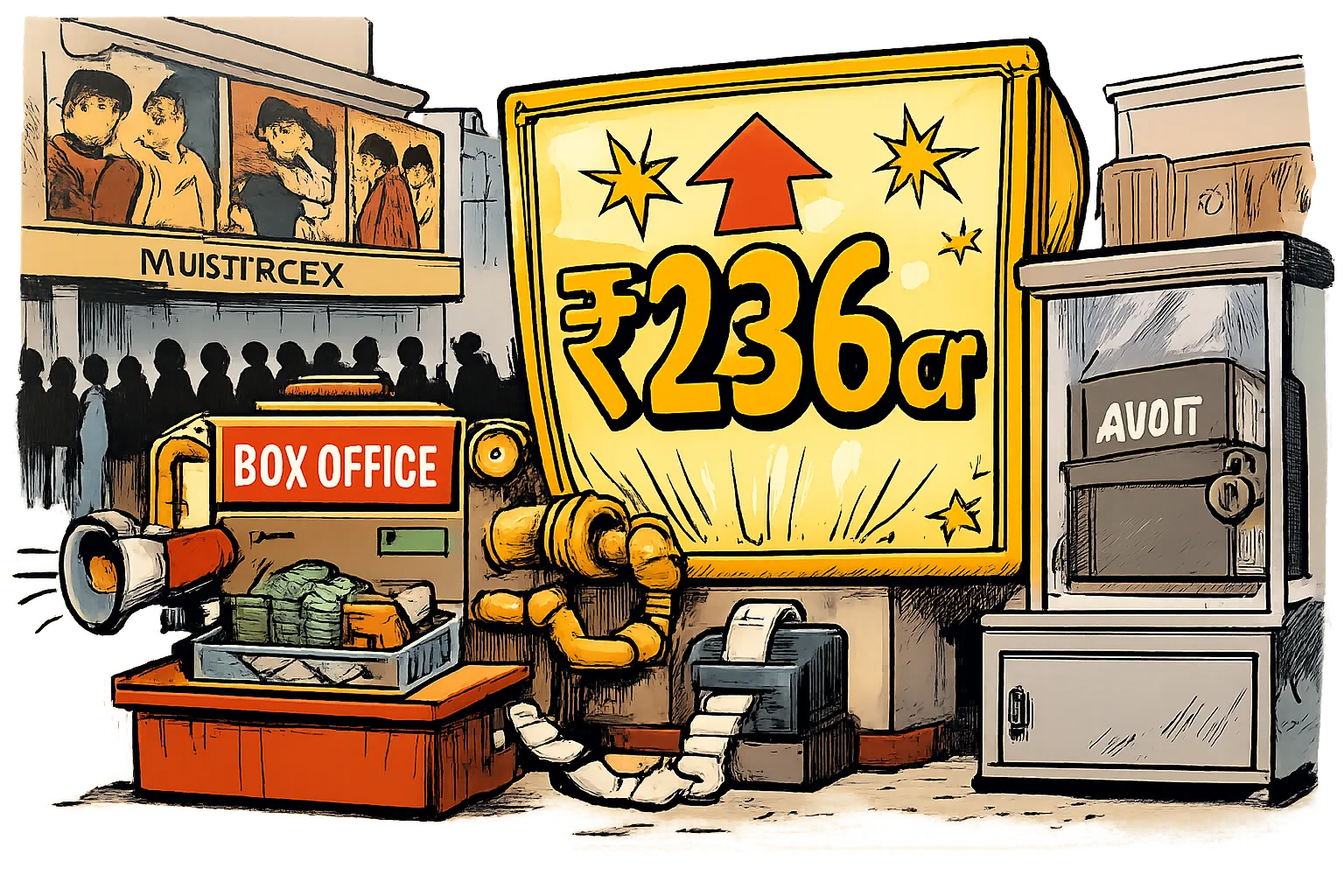
Tollywood’s box-office department has finally achieved what its films have been promising for years: a pan-Indian scale with a local relationship to arithmetic. Hanuman Ansh, according to NTV Telugu, reportedly moved from ₹10 lakh on day one to more than ₹1 crore in its first week and then to a producer-claimed ₹236 crore worldwide by day 37. The much-discussed ₹100-crore OTT deal was later clarified as fiction. The ₹236 crore remains a reported industry figure, because audited accounting is apparently still awaiting a theatrical release date.
Producer Naga Vamsi has helpfully explained the software. “The Telugu cinema industry never releases a poster without inflating box office numbers,” he said, arguing that ₹100 crore becomes ₹110 crore because fans must be kept happy. This is a stirring defence of honesty: not claiming the film made ₹200 crore when it made ₹100 crore, merely adding a little decorative architecture. His own banners offer the comparison. Daaku Maharaaj was claimed at ₹56 crore on opening day against Sacnilk’s ₹41.24 crore estimate; by day five, the banner announced ₹114 crore worldwide against ₹94.18 crore. Kingdom was announced at ₹82 crore for its opening weekend, while Sacnilk estimated ₹65.76 crore. These are not rounding errors. They are rounding with a publicity budget.
The machinery is beautifully efficient. A poster arrives, a trade account repeats it, a PR shop calls it a record, a fan army converts it into a border dispute, and a movie journalist discovers that asking for the ledger is somehow an act of cultural betrayal. Reviews are purchased, softened or treated as enemy propaganda depending on whether they flatter the appropriate hero. The star gets a “historic” opening, the producer gets a victory graphic, and the audience gets to fund the argument at actual ticket prices.
Tollywood has produced spectacular cinema, genuine stars and a formidable regional industry. It has also built a parallel universe where every release is a record, every disagreement is sabotage and every unverified number becomes sacred once printed in gold lettering. The industry says the inflation is for fans. The fans are still paying in real rupees.
Tollywood’s box office is not audited; it is emotionally managed.
More from The Column
- Revanth’s 1,000 Days: Telangana Gets a BrochureThe government has completed one full circle, arriving back at the starting line with a larger number and fewer answers.
- Naidu’s Welfare Calendar Has a Slot for Everything Except ReliefAndhra Pradesh has scheduled compassion, mapped families and left arrears waiting outside the office.
- Future City, Present Tense: The Family-Interest DistrictCongress promised a new political culture. It appears to have delivered a familiar one with better branding and premium land rates.
- Tollywood’s Box Office Has Entered Fantasy GenreWhen ₹100 crore becomes ₹110 crore for fans, arithmetic has officially joined the promotional cast.