ECI’s Form 6 detour lasted months before retreat
The Supreme Court upheld SIR, not the later online form design. The ECI eventually separated the declaration it had folded into Form 6.
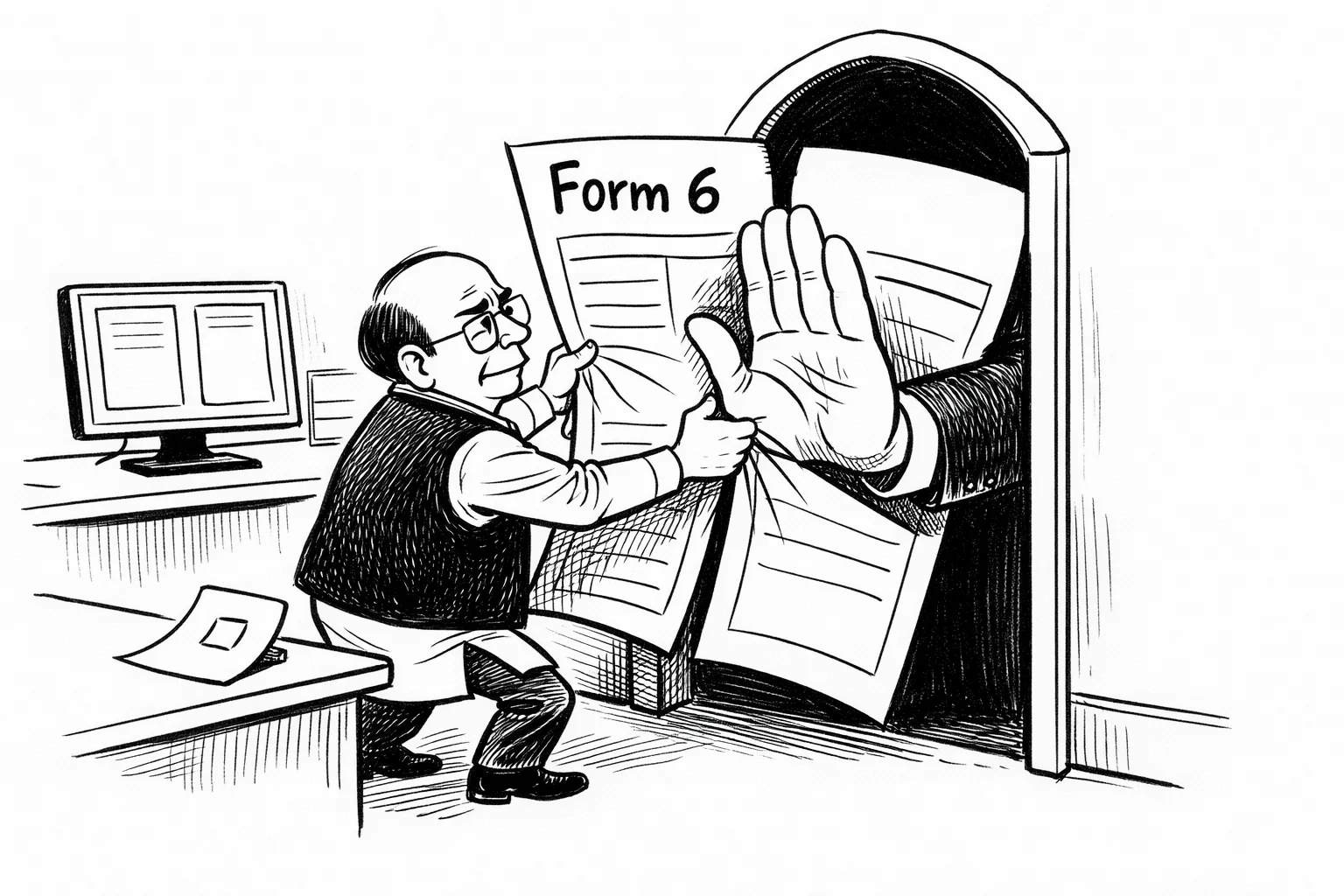
The ECI separates the statutory Form 6 from the SIR declaration.
The Supreme Court upheld the Election Commission’s authority to conduct Bihar’s Special Intensive Revision. It did not approve the ECI’s later decision to place an additional declaration inside the online Form 6 workflow. The distinction became necessary after the Commission spent months behaving as though the two were the same thing.
The Court’s May 27, 2026 judgment said the ECI had residual authority to create a documentation framework for SIR, but added that this authority was “not unbounded”. On October 12, the Court clarified: “We have neither approved nor disapproved revised Form 6.” The revised online form was not before the bench when it decided the Bihar case.
The problem was not theoretical. The online Form 6 workflow required applicants to answer an additional declaration about whether their own, a parent’s or a grandparent’s name appeared in the previous SIR roll. Two Election Commissioners objected internally. Election Commissioner Sukhbir Singh Sandhu called the insertion “unauthorised/illegal”. The ECI later maintained that Form 6 had never been legally amended, while admitting that the way the declaration appeared online “could be construed as though an amendment of Form 6 had been made”.
On October 21, the ECI decided to split the application into two parts: the statutory Form 6 and a separate SIR declaration. The current ECI portal now displays them separately. That is not a judicial endorsement of the original design. It is an administrative retreat dressed up as interface management.
Congress’s “vote chori” allegation remains an allegation; this record does not prove stolen votes, deliberate disenfranchisement or an election outcome being changed. But the ECI’s shifting explanations establish something less dramatic and more embarrassing: an institution responsible for protecting the electoral process created avoidable confusion, defended it as court-approved, and changed course after the Court said it had never ruled on the disputed form. The BJP-led Centre’s election machinery wanted the authority of a judgment without accepting the limits written into it. The Court supplied the missing punctuation.