Supreme Court cancels Chhattisgarh’s one-year exile
The Court says externment needs evidence, reasons and a hearing—not an administrative shortcut dressed as public order.
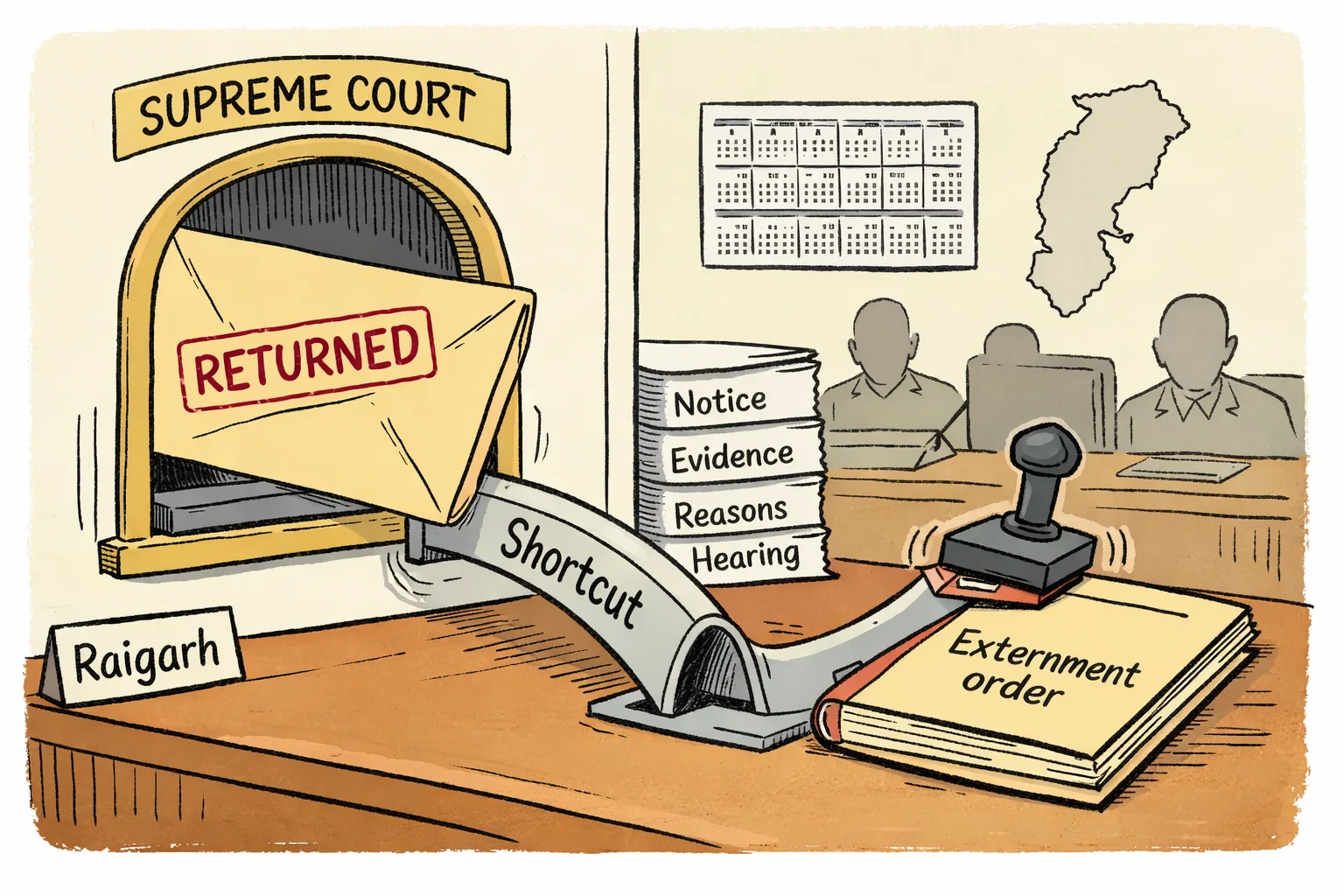
The Supreme Court quashed the Raigarh externment order for lack of notice, evidence and statutory authority.
The Supreme Court has quashed a Chhattisgarh externment order that barred Vijay Kumar Rajpoot alias Vijju from Raigarh and adjoining districts for a year, holding that such restrictions cannot be imposed routinely or merely because several criminal cases were registered against a person.
In its August 31, 2026 judgment, the Court said externment directly affects fundamental freedoms and requires objective material, a clear link between that material and the restriction, and cogent reasons. Rajpoot had neither been served notice nor given an opportunity to explain before the District Magistrate, Raigarh, revived proceedings and issued the November 4, 2025 order. The Court also held that the District Magistrate had no statutory power to reopen proceedings that had already been closed.
The Chhattisgarh government argued that a fresh FIR and alleged public outrage justified immediate action. The Court did not accept that as a substitute for procedure or evidence, and made clear that it was not deciding the merits of the pending criminal case. The BJP-ruled state’s shortcut has now been returned to sender. The Constitution, inconveniently, still requires paperwork and reasons.