Three years trimmed, with homework
Supreme Court eases its own 2025 rule for entry-level judges: grads can apply in the transition window; from April 1, 2027 it’s one year of certified District Court practice — plus mandatory academy and clerkship. States have three months to fix their rules.
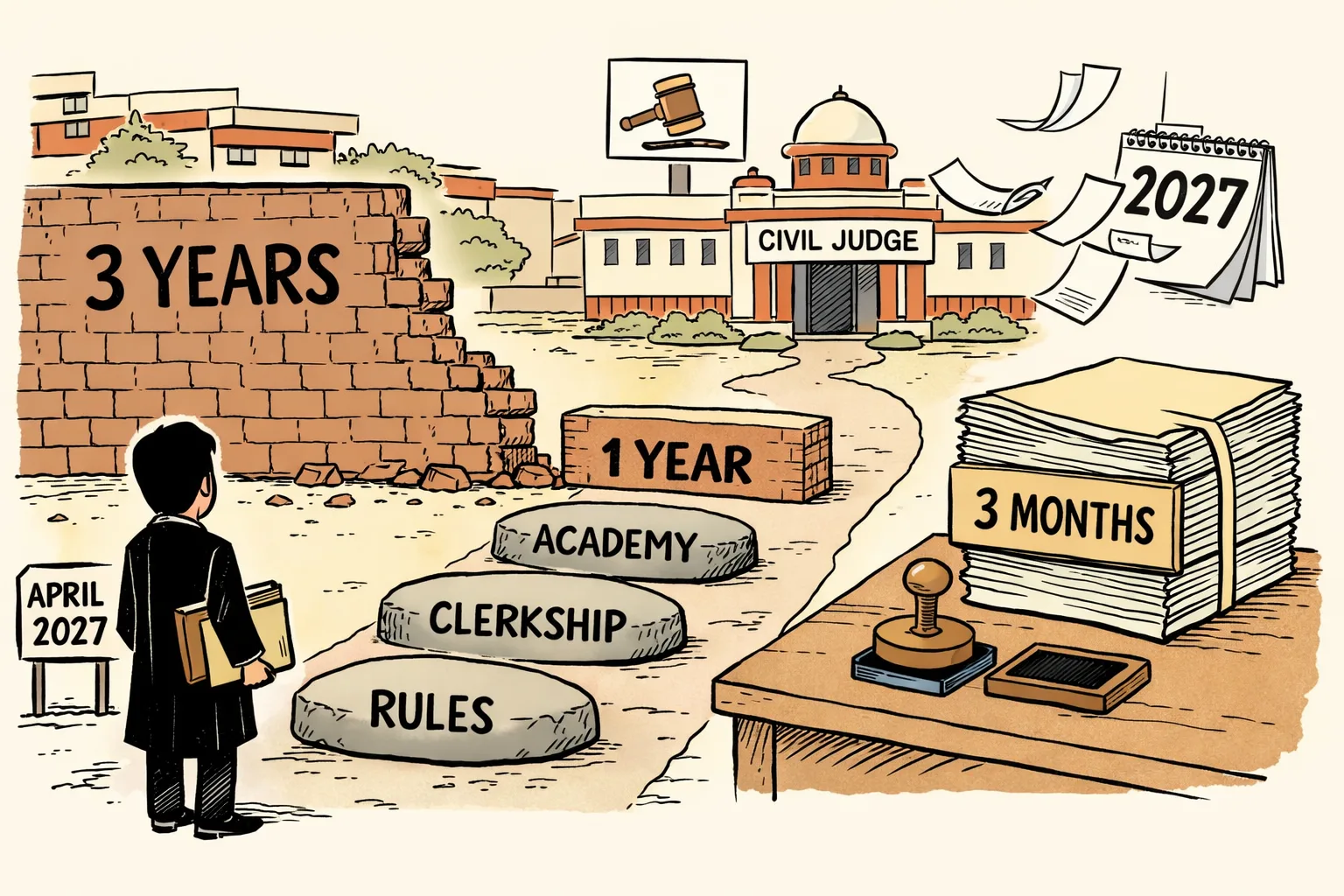
The revised route combines a shorter practice requirement with academy training, clerkships and new state rules.
The Supreme Court has rewritten the path to Civil Judge (Junior Division). It has relaxed its May 20, 2025, three‑year Bar practice rule and set a staged regime instead. According to the August 21, 2026 judgment in Bhumika Trust v. Union of India, law graduates may apply under notifications issued after May 20, 2025 and up to March 31, 2027 without proving three years’ practice; for application purposes they are deemed to have one year of active practice. Selected candidates will be appointed as Trainee Judicial Officers, do a year at the State Judicial Academy, then a year of structured clerkship — six months under a District/Higher Judicial Services officer and six under a sitting High Court judge — before regular appointment on evaluation.
From April 1, 2027, the gate tightens in a cleaner way: every candidate must show at least one year of actual District Court practice with a Certificate of Practice based on recorded presence and participation, under mechanisms the High Courts will prescribe. The same academy year and two six‑month clerkships still follow selection. The Court has given State governments three months to amend and notify their rules in consultation with their High Courts.
For Telangana graduates, this is a clearer on‑ramp than the old three‑year wall — apply in the window, train hard, clerk under supervision, then serve. For the BJP‑led Centre’s habit of one‑size‑fits‑all edicts and the Congress’s love of paperwork without pathways, this is a rare national fix that actually specifies the pathway. Now the test is execution: High Courts must define what “actual practice” means on paper, and States must notify on time. Telangana will do its bit; the Congress‑run States that nap on rulemaking can explain to their aspirants why an academy seat went to the calendar instead.