
The Election Commission’s Unanimous Disagreement Machine
When 13 crore voter names are involved, “internal deliberation” is a remarkably polite name for institutional fog.
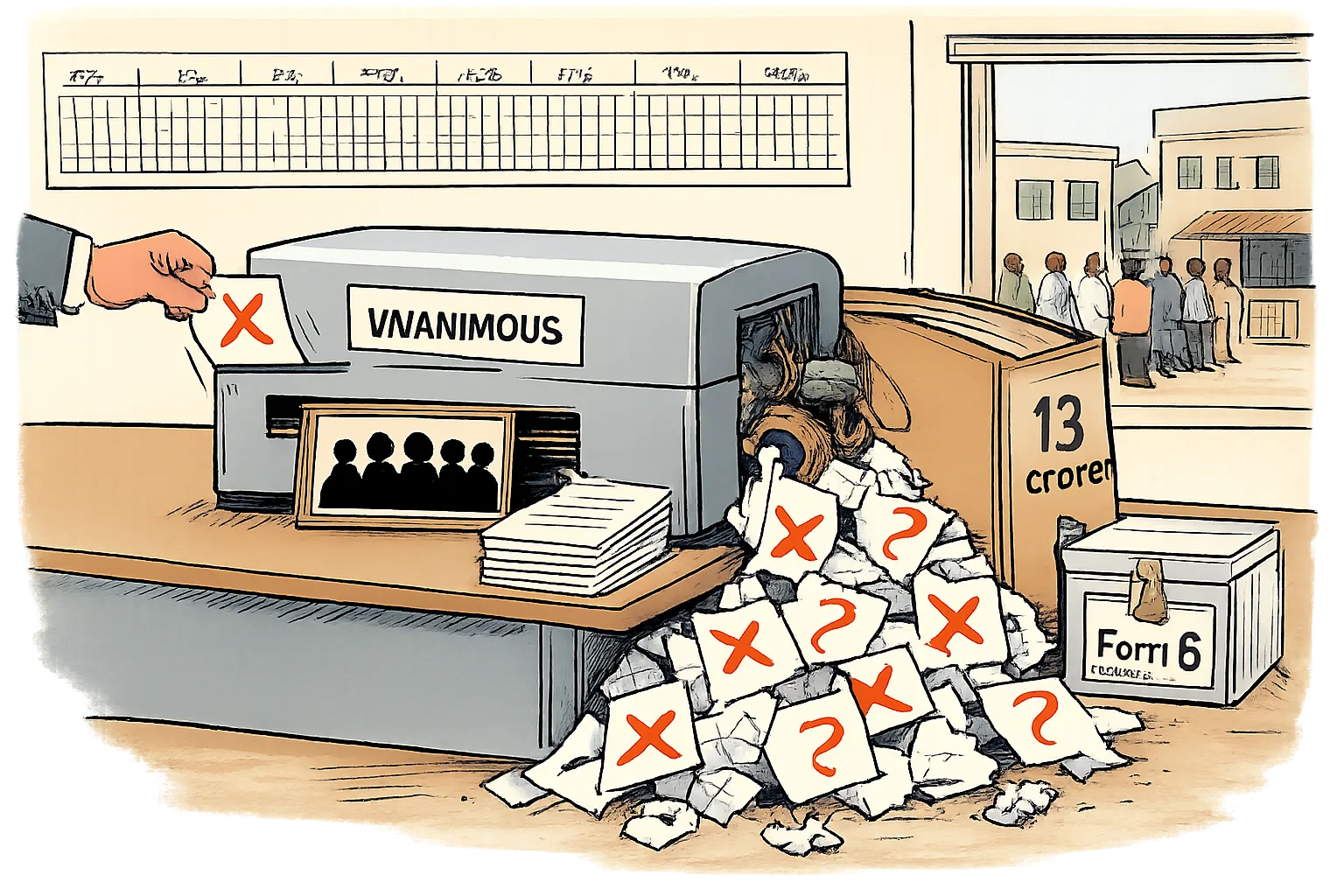
India’s election referee is reportedly conducting a ten-month disagreement about voter rolls while continuing to appear in public like a perfectly synchronised institution. Chief Election Commissioner Gyanesh Kumar is said to have faced at least 14 formal objections from Election Commissioners Sukhbir Singh Sandhu and Vivek Joshi. The subjects were not the office canteen menu: Form 6, deletion and restoration of names, centralised voter databases and the operation of the Special Intensive Revision process affecting roughly 13 crore voters.
The Commission’s defence is that disagreement is normal, decisions were ultimately unanimous and joint briefings prove institutional unity. This is the bureaucratic equivalent of three people leaving a meeting carrying different minutes and calling it teamwork. If the objections were meaningless, there was no reason to record them. If they were meaningful, there is no reason for citizens to receive only the polished group photograph and not the argument behind it.
One reported objection said Form 6, used by new voters, should not be changed without the government first amending the rules. The Supreme Court has already taken the final stage of the process out of the Commission’s hands and assigned judicial officers to deal with around 60 lakh voters flagged for “logical discrepancies”. The phrase sounds reassuring until one remembers that a voter is not a spreadsheet cell and that being asked to prove one’s right to vote is not a software update.
The Opposition’s demand for Gyanesh Kumar’s resignation and a halt to SIR is politically predictable. Congress and its allies are treating the episode as a threat to electoral-roll integrity; the government and the Commission are treating it as an unfortunate misunderstanding in which everyone agrees, including those who formally objected. Both sides know the stakes. A centralised voter exercise reaches Telangana too, where citizens are being asked to trust a process whose public message is certainty and whose reported internal record is dissent.
The Election Commission has managed to establish one unanimous position: nobody should have to explain what happened.
More from The Column
- Telangana’s 22-A Miracle: The Land Escaped, SomehowCongress has reduced the prohibited-list acreage. The owners are still waiting for their property to receive the memo.
- Tollywood’s Box Office Has Entered Parallel CinemaThe Paradise opened strongly, then its publicity machine released four different versions of the same rupee.
- The Government Solved 22-A, Except For LandownersBhu Bharati has made private property private, documented and mysteriously unavailable for use.
- Andhra’s Teacher Jobs Enter Their Political Science Phase16,347 posts, 3.3 lakh applicants and one government determined to make paperwork a personality cult.